Research Overview
Electrochemical devices — from lithium-ion batteries to protonic ceramic fuel cells — are central to enabling clean energy technologies. Their performance and lifetime depend critically on the coupling between electrochemical reactions, material transport, mechanics, and microstructure.
Our group develops finite-element–based electro-chemo-mechanical models to understand these interactions across scales, from active particles to full devices.
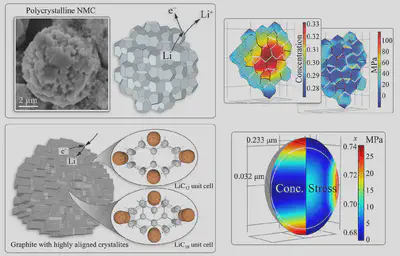
1. Chemo-Mechanical Modeling of Electrode Materials
We create FEM formulations that capture diffusion-induced stress, anisotropic deformation, and phase-transformation mechanisms in electrode materials such as:
- Polycrystalline NMC cathodes
- Highly anisotropic electrodes
- Single-crystal and polycrystalline electrodes
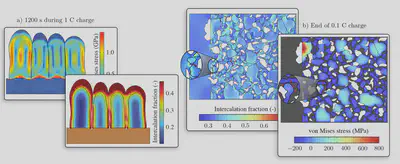
- Silicon anodes with extreme volumetric expansion
These models resolve transport, mechanics, and interfacial behavior simultaneously, enabling prediction of:
- Stress localization
- Grain-boundary failure
- Crack initiation and propagation
- Degradation mechanisms under fast charging
- Influence of particle geometry and anisotropy
2. All-Solid-State Batteries
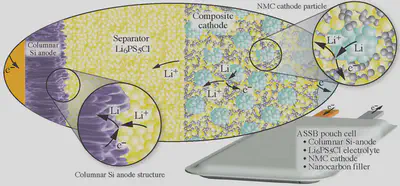
A major research direction focuses on all-solid-state lithium batteries (ASSBs), where solid–solid interfaces introduce fundamentally different deformation and degradation pathways.
Our models incorporate:
- Argyrodite (Li₆PS₅Cl) solid electrolytes
- Polycrystalline NMC cathodes
- 3D microstructures from tomography
- Columnar silicon anodes
- Interfacial mechanics and decohesion
- Fabrication pressure and residual stresses
We simulate:
- Stress evolution during cycling
- Interfacial delamination
- Lithium transport in heterogeneous microstructures
- Particle-scale fracture
- Influence of microstructure on lifetime
3. Protonic Ceramic Membranes & Electrolyzer Materials
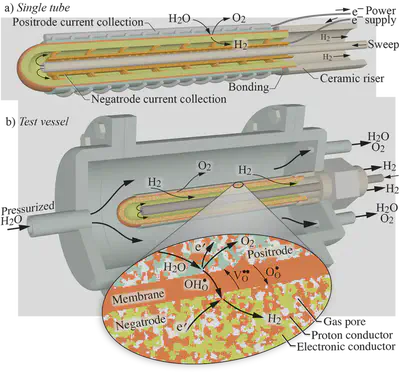
Our group also analyzes protonic ceramics and high-temperature membrane materials, focusing on:
- Coupled thermal–chemical–mechanical behavior
- Stress generation during hydration/dehydration
- Interaction between grain boundaries and proton diffusion
- Failure prediction under long-term cycling
These models unify transport of protons, oxygen vacancies, and species diffusion with nonlinear mechanics.
4. Future Directions
We are expanding our work toward:
- Fracture in sodium-ion and multivalent batteries
- Fabrication-informed models with residual stresses
- Phase-field fracture in solid electrolytes
- High-fidelity, tomography-informed 3D microstructures
- Multiphysics models of electrolyzers and hydrogen devices
- Computationally scalable solvers for large-deformation chemo-mechanics
5. Impact
Our methods support materials discovery and device optimization in:
- Energy storage (Li-ion, Na-ion, ASSB)
- Fuel cells and electrolyzers
- Hydrogen compression technologies
- Membrane reactors
- Solid oxide devices
The resulting frameworks guide industry and national-lab partners in improving durability, energy density, and safety.
This multidisciplinary environment enhances our ability to tackle complex challenges in electrochemical systems modeling.